[en]This Sunday, my iai-do group, the Renshinkai, had our yearly demonstration at Yasaka shrine in the Gion district of Kyoto. Yasaka shrine was first constructed starting in 656 AD. It’s become one of the most famous shrines in Japan and a sightseeing destination for hundreds of thousands of people visiting traditional Kyoto every year. The ability for us to be on the main stage there, and dedicate our performances to all the history which surrounds this historical place is such a privilege.
Considering that these demonstrations are done at Shinto shrines, we first sit through a ritual performed by a priest and receive his blessing. As we leave the inner shrine, we take a sip of sacred sake, and prepare ourselves for demonstration on a stage is open on four sides so that spectators can see from all sides. About thirty of us show 5 waza (choreographed sets of techniques) each, and it takes over an hour for us to finish.
Hundreds of tourists came by during that time, asking questions, taking pictures and marveling at this living piece of Japanese culture and history. It’s always exciting for me to not only take part in this myself, but also an honor to be able to share my love for it with others!
I’ve practiced iai-do for over 4 years now in Japan, and it’s absolutely my favorite part of Japanese culture. Being here as a JET for 5 years has given me the opportunity to experience Japan in ways like this, and is a debt that is difficult to repay.
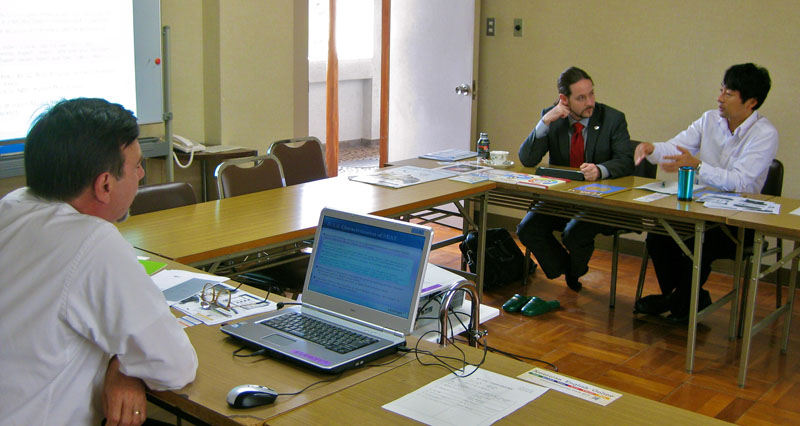
[en]Today I took a trip to the southside of Osaka prefecture to Izumi High School, where Toru Nakahara is Prinicipal. There, we met up again with Public Affairs office staff member Eri Nakanishi, and RELO George Scholz, based at the American Embassy in Seoul.
It has been around four months since our last meeting, and we all had lots to catch up on. Personally, I’ve been doing a lot of planning as well as trying to develop a solid plan for English education for first-time learners, so I had a lot of questions about Korea’s implementation of elementary school English.
After a couple of hours, we had learned a lot! Mr. Scholz gave us an in-depth review of what’s happening in Korea, where they are doing some truly great things. They’ve created their own tests and are doing consistent research and evaluation and adjustments to their programs across the country. They implemented English education in 1997, which puts them more than 15 years ahead of Japan at the moment. While it is obvious that we are well behind, I still feel that we can easily (and quickly) catch up and start giving our kids the education that so many want.
Mr. Nakahara was able to learn a variety of background information on Korea’s “NEAT” English tests for high school, as well as how TOEIC and TEFL tests are being used and what students need to prepare themselves for college and studying abroad.Overall, it was another fantastic meeting, and I’m looking forward to the next time that we can work together! Thank you as always, U.S. State Department officials.
[/en]
[ja]本日、私は、大阪の南に位置し、中原徹校長が勤務されている和泉高等学校へ訪れました。そこでは、大阪アメリカ総領事館広報・企画課の中西えり氏、在ソウルアメリカ大使館からRELOのジョージ・ショルツ氏に再びお会いしました。
[en] Last week, the 2011-2012 AJET Council wrapped up its year of service to the JET Programme with the Spring Opinion Exchange. Members from MEXT, CLAIR, MOFA, and MIC were present as AJET presented its bi-annual research and some of its final projects of the year.
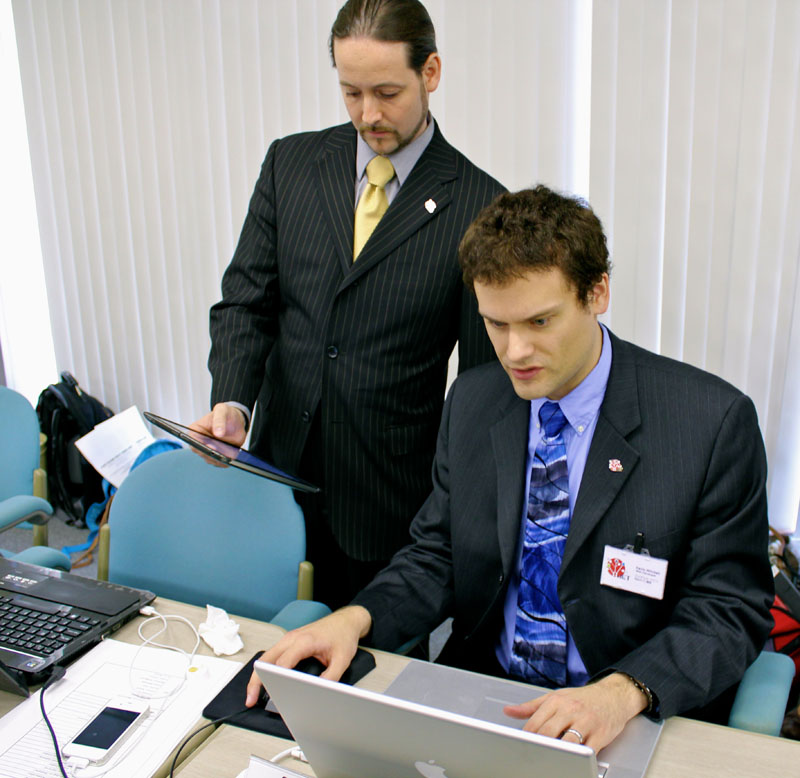
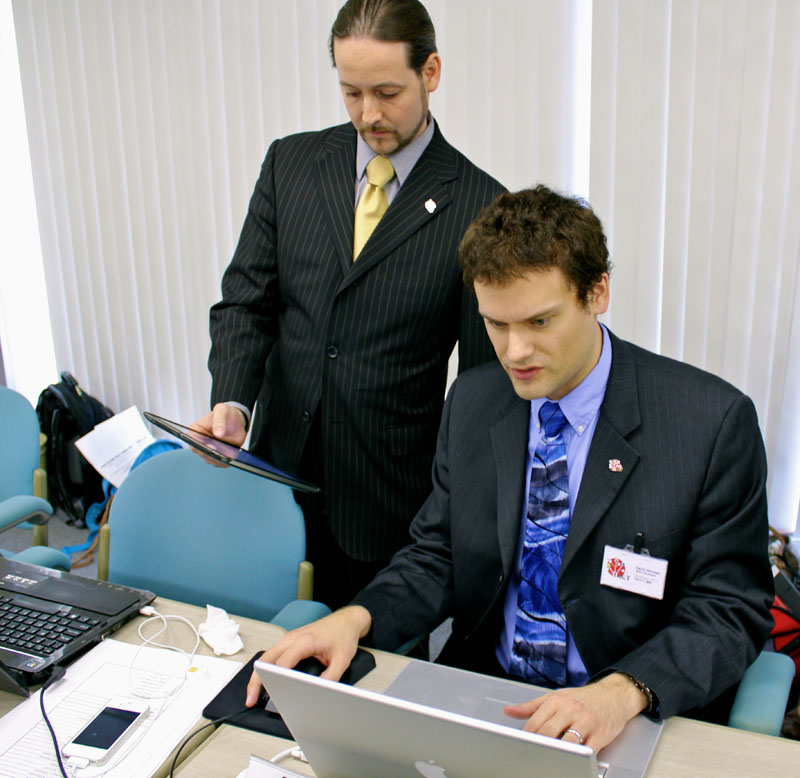
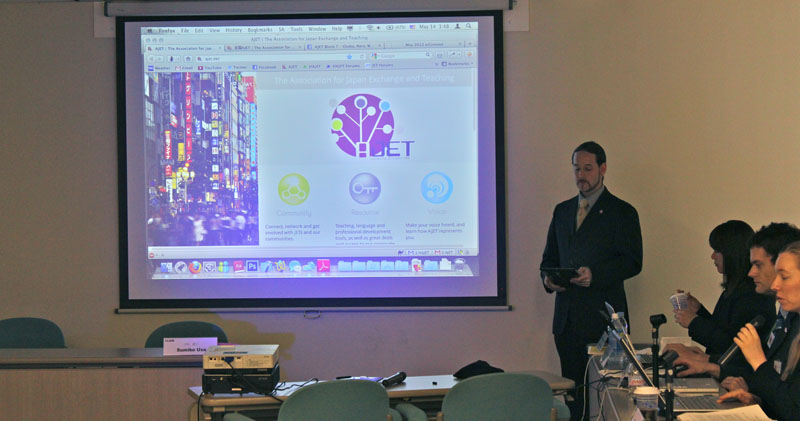
First, myself and AJET webmaster Kevin Mitchell led a presentation on the General Activities Report. This report was a lot of fun to present, because it gave us a chance to unveil, and demonstrate the mobile app we’ve been working on!
For those of you not familiar with the AJET app, Kevin Mitchell has been developing it for over six months, and its release coincided nicely with the Opinion Exchange. Using my iPad in the CLAIR conference room, I showed the ministry representatives all the features he’s been hard at work on. Some of these features include lesson plans on-the-go, mobile access to our magazine, and Japanese language reference for real-life situations. For example, what to say at the doctor’s office, or what to say when you call an emergency number in Japan for help.
One of the reasons AJET set out to make an app was because often JETs (and other ex-pats in Japan) find themselves in situations where they need easy access to very specific information that is unique to the experience of living abroad. Kevin even created a Japanese year converter, a weight and measurement converter, and translations of product labels on foods and household items like remote controls and washing machines! It was a lot of work developing the app over these past few months, but I truly believe our product can make a difference in countless people’s lives!
Finally, this Opinion Exchange was unique because it was the first one in which we were allowed a new format for discussion our research and ideas. Rather than sticking to a tight schedule of report presentation and pre-approved questions, we had time for open, unscripted discussion. It was during this that I presented a proposal for a JET awards system, co-sponsored by AJET, JETAA, and the ministries. The ministries also had time to ask AJET for updates on work that they were particularly interested in, including the AJET relief fund.
As this was the last chance for me to meet with the ministries as the Chairman of AJET, it was both exciting and sad. I feel like we brought a lot of new services to JETs this year. Looking forward, I hope next year’s council is even more successful in bringing services to JETs, and increasing the visibility of this great Programme! [/en]
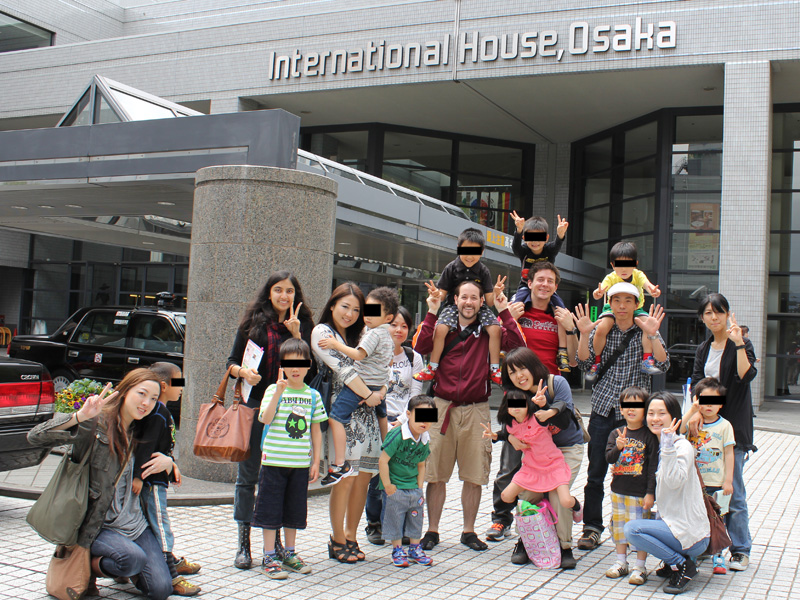
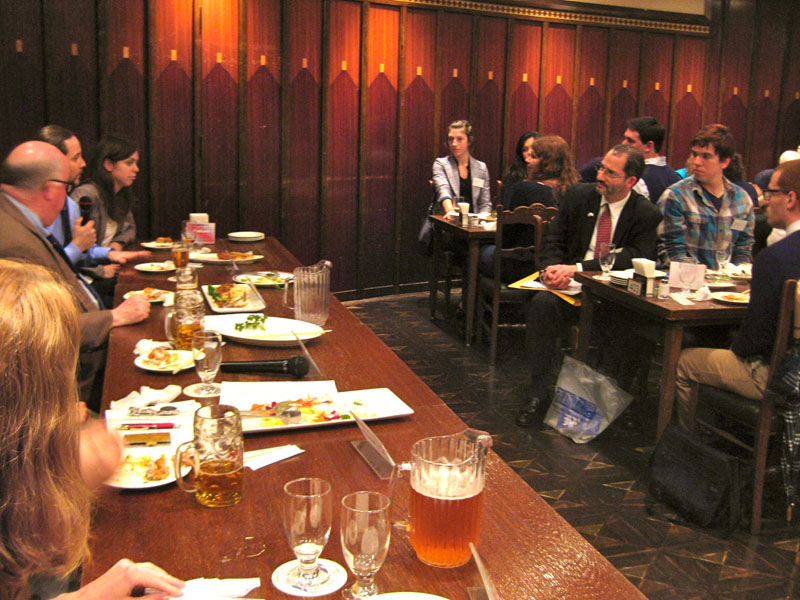
[en]Performance at Osaka International House[/caption]This weekend, was an exciting one! We have been working with the Osaka International House, which is a public-service corporation founded by Osaka City in 1887, and authorized by the Ministry of Foreign Affairs in 1993, as well as the Cabinet in 2012. Recently we’ve worked with them on several projects. They have the same goals of internationalization, and they provide lots of great services to foreigners in Osaka. This weekend, they set us up with some amazing performers who put on a show about classical music just for kids.
For the past year and a half, myself and other JETs/JET alumni have been volunteering every other weekend at an orphanage in Osaka. It’s really been one of the most fulfilling, and fun, things I’ve done in Japan. We play, sing, make crafts, and teach English to 3-6-year-olds.
Thanks to help from the Osaka International House, Mariko Mukai, Carl Farlow, Miki Minami, Maruyama Tetsuji, Aakruti Vakharia, and myself were able to take the kids to this great show!
Performance at Osaka International HouseWe picked the kids up an hour and a half before the show’s start for the long walk there, which included lots of carrying them around on our shoulders. After getting there, we had some spare time until the show, so we drew on scrap paper with them and chatted while we waited.
Of course, I couldn’t resist using the time to let one of the kids try some Alphabet and Phonics games out on my iPhone! It’s really amazing to watch a young learner with technology. Things that take adults time to figure out, they learn in a fraction of the time! Before I knew it he was typing, writing, and drawing away on my iPhone, and learning the alphabet.
The show was a blast. There was a piano player, and the MC was an opera singer dressed colorfully with feathers all over him. We also saw a guitar player and violinist, and a man playing a saw. (An actual saw, that you could cut a tree down with, using a bow similar to a bow from a violin). These guys were truly talented, and I can’t thank them enough for the show they put on, and for an unforgettable day with the kids!
For more pictures of the event, click here.
[/en]
[ja]この週末はとても楽しいものとなりました!近頃、いくつかの事業でご一緒することがある、大阪国際交流センターは、(昭和62年に大阪市より設立され、平成5年に外務省より「特定公益増進法人」の認定を受ける。また今年、平成24年3月には内閣省「公益財団法人大阪国際センター」認定を受ける。)国際化に対して、同じ目標を掲げた団体ということもあり、大阪在住の外国人にたくさんの素晴らしいサービスを提供されています。この週末は、素晴らしい音楽家の方が作り上げる子供達のためのクラシック音楽のコンサートを私たちに提供してくださいました。